
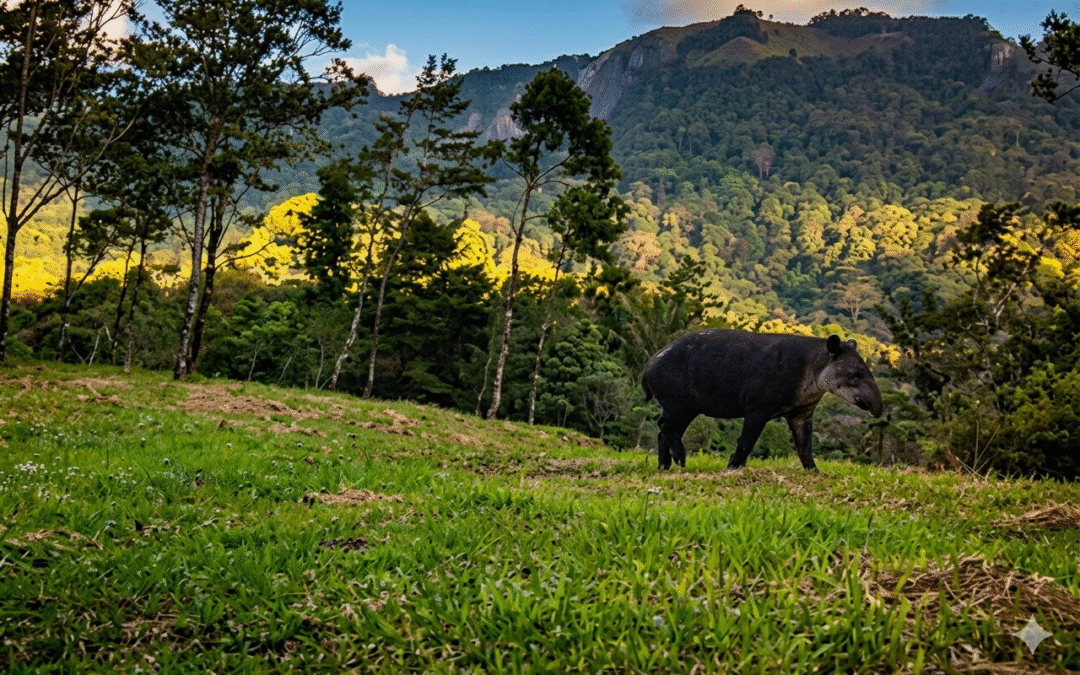
In Costa Rica, the tapir is known as danta. A name shaped by generations who have shared the forest with this animal long before scientific terms like Tapirus bairdii became common. It’s local, grounded, and deeply connected to place.
There are few animals in the rainforest as quietly powerful as the danta. Mostly nocturnal and rarely seen, it moves through the jungle shaping ecosystems in ways that often go unnoticed.
But not all tapirs are the same. Across the world, four species have evolved in very different environments. Today, all four species are celebrated, each one playing an essential role in its ecosystem, three in Latin America and one in Asia.
A closer look at tapirs around the world
| Species | Region | Habitat | Key characteristics |
|---|---|---|---|
| Tapirus bairdii | Central America (Costa Rica) | Tropical rainforests | Largest in the region, key seed disperser |
| Tapirus terrestris | South America | Rainforests and wetlands | More adaptable and widespread |
| Tapirus pinchaque | Andes | Cloud forests | Smaller, adapted to cooler climates |
| Tapirus indicus | Southeast Asia | Tropical forests | Distinct black and white pattern |
Here in Costa Rica, the danta is the largest land mammal in Central America. Its role is simple but essential. As it moves through the forest, it disperses seeds across long distances, helping regenerate the ecosystem naturally.
And yet, its presence is becoming increasingly rare.
Armonía: where presence becomes proof
At No Limit Adventures, Armonía was created to restore what was once fragmented. Not by forcing nature, but by giving it space. What we’re seeing now is not random. It’s a pattern. From all the camera trap footage, two moments stand out as the most meaningful.
1. The night crossing
A danta moving slowly through the frame in near darkness. No rush. No reaction. Just a steady, habitual path.
This matters because it suggests routine. Tapirs don’t wander aimlessly. They follow established routes. When you capture this, you’re not just documenting movement. This is not a random encounter, it’s a pattern.
2. The early light presence
A second clip, with more natural light, where the animal appears equally calm.
This is even more significant. The Tapirus bairdii is highly sensitive to disturbance. Seeing it outside deep nighttime hours, without signs of stress, suggests something critical. It feels safe.
Why these moments matter
Out of all the recordings, these are the ones that tell the real story. Not just that the danta passed through, but that it is beginning to use the space consistently. Something to highlight:
- Calm movement.
- Repeated presence.
- No signs of stress.
That’s what restoration looks like in practice.
Travel that gives something back
Costa Rica’s wild places don’t exist by accident. They are protected, restored, and, in some cases, brought back to life. At No Limit Adventures, every journey is designed with that in mind. Armonía is not separate from the experience. It’s part of what we build, and part of what we leave behind.
Because protecting species like the danta doesn’t start in theory. It starts when the forest becomes a place where they can return and stay.